The Fayum Oasis, situated in Middle Egypt and watered by the Nile, has long been a vital agricultural and cultural hub. The name “Faiyum” derives from the Coptic word for “the Sea” or “the Lake”, reflecting its ancient association with a vast body of water. Today, Lake Quran represents a diminished remnant of the prehistoric Lake Moeris, which once spanned much of the oasis and supported abundant life, including scores of crocodiles that played a central role in local mythology and religion.
In Ancient Egypt, Faiyum’s principal settlement was Shedet, where the crocodile god Sobek held paramount reverence from the region’s earliest documented history. Evidence suggests Shedet may have indeed been Sobek’s primary center, if not his point of origin.
The founding myth of Shedet was recounted by the Greek historian Diodorus in his Bibliotecha Historica. King Menes, the semi-mythical unifier of Upper and Lower Egypt, was pursued by his own hunting dogs to the edge of Lake Moeris. A crocodile emerged, and carried him safely across the waters to the opposite shore. Intensely grateful, Menes established the “City of Crocodiles” and required all local inhabitants to worship the crocodile god.
Under the Greeks, Shedet became known as Krokodilopolis, or “Crocodile City”, and a living sacred crocodile named Petsuchos “he who belongs to Suchos” (Suchos being the Greek rendering of Sobek), was house in a temple lake, adorned with gold jewelry and gemstones, fed choice offerings by priests and pilgrims. Classical authors tell us that visitors presented gifts to Petsuchos, who embodies Sobek’s presence. Upon death, these crocodiles were mummified and interred, with their mummies having been found in vast necropolises.
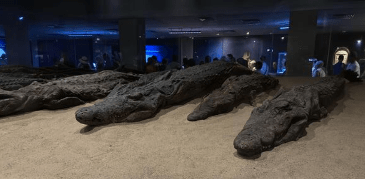
While there were inklings of a Sobek-Horus connection that appeared in the Old Kingdom, a full syncretism didn’t occur until the Middle Kingdom. Amid the Faiyum’s ascent as an economic and political powerhouse under the Twelfth Dynasty, Sobek-Horus emerged, particularly strong in Shedet. The syncretism aligned the local crocodile cult with the royal god of kingship, allowing rules of Shedet to bolster their legitimacy. This fusion served to integrate local cults with national royal ideology.
Amenemhat III actively promoted the union of Sobek-Horus, constructing temples and commissioning monuments. “Sobek of Shedet – Horus who Resides in Shedet” abound in stelae, temple inscriptions, and statues, where Sobek adopts Horus’ falcon head, plumage, or solar disk. One notable relief from a temple depicts Sobek-Horus conferring royal power opon Amenemhat III, addressing him as “beloved son of my flesh”, with the cobra goddess Renenutet (Sobek’s consort and harvest deity) attending as a divine witness (1)
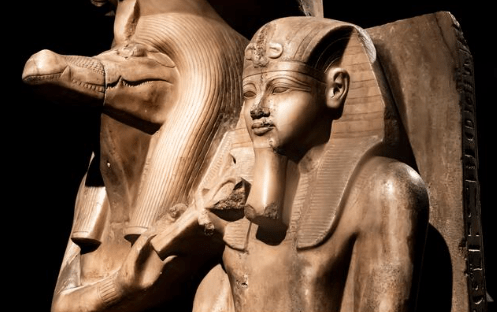
Sobek-Horus of Shedet represented a evolution of sorts of Sobek’s deeply ambiguous character. In Shedet, this form of Sobek appears most ‘civilized’, as he was integrated into state religion. This assimilation shifted Sobek’s parentage from Neith to Osiris and Isis, expanding his theological scope and addressing provincial identity within a unified Egypt. He was the son and protector of Osiris, involved in the royal cycle of death, rebirth, and renewal.
Sobek-Horus of Shedet was also loved by the common people, who sought his benevolence for prosperity, protection, and fertility. Numerous votive statues, stelae, and offering formulas are attested from non-royal individuals in widespread devotion. He was invoked for health, bountiful harvests, and safe travels. Yet, even here, Sobek’s baleful aspect lingered, as he is both and always benevolent and notoriously dangerous.
Hymns and incantations praised Sobek-Horus as “he who rises from the flood, falcon of the sky”, invoking a dual role of fertility and kingship.
Festivals here, as elsewhere, were key communal events, with processions carrying Sobek’s image accompanied to music, dancing, and feasting. Oracles, derived from observing the behavior of the sacred crocodile and interpreting dreams, provided guidance on state and personal matters. Devotion was shown by scores of votive offerings, such as small statues, stelae, and plaques inscribed with prayers and deposited at temples. At Shedet, pilgrims visited sacred crocodile enclosures, presenting gifts and seeking oracles.
Priestly titles in the region reflect the cult’s organization:
- Lector Priest of Sobek of Shedet
- Overseer of the Divine Offerings of Sobek of Shedet
- Brewer of the Divine Offerings of Sobek of Shedet
- Chief of the Temple Performers of Sobek of Shedet
These roles involved ritual maintenance, oracles, and festivals, with theophoric names incorporating “Sobek” (i.e. Sobekhotep) surging in popularity during the Middle Kingdom, especially in the Faiyum.
Sobek-Horus spread beyond the Fayum, manifesting prominently in the New Kingdom and solidifying at Kom Ombo’s dual temple during the Ptolemaic era. The temple, dedicated to Sobek (with Hathor as his consort and Khonsu as their son) and Haroeris (Horus the Elder), has a unique symmetrical design.
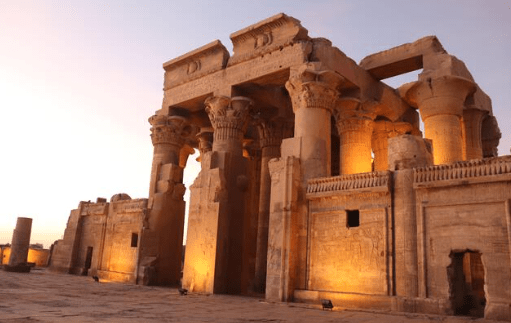
Sobek-Horus usually appears as a falcon-headed figure with a solar disk, labeled “Sobek-Horus, Lord of the Two Lands”. He also appears as a crocodile with falcon plumage or a solar crown, holding the ankh, was-scepter, and various weapons. Hymns praise him as “he who rises from the flood, falcon of the sky, protector of the Two Lands”, emphasizing his role as a warrior king who has united Egypt. This ‘civilized’ form tempered Sobek’s ambiguity, integrating him into the Osirian cycle as ally and protector.
Sobek-Horus reached his apogee in the Ptolemaic and Roman periods. The Ptolemies elevated syncretic deities like Sobek-Horus, expanding temples in the Faiyum and Kom Ombo, where crocodile mummification and festivals persisted. Until the decline of paganism in the late Roman era, Sobek-Horus endured as a symbol of Nile-dependent prosperity, combining local reverence with imperial ideology in Egypt’s fertile heartlands, in regions that were tied to the Nile’s economic importance.
- (1) Zecchi, Marco (2010). Sobek of Shedet, The Crocodile God in the Fayyum in the Dynastic Period.
 Dua Sobek