Amun, now largely forgotten in the current Egyptian religious revival, was one of the most significant deities in Ancient Egyptian religion. His name means “hidden, invisible”, from mn or imn “to hide, to conceal”, and he was associated with the unseen and transcendent. Amun is the hidden force and has no visible theophany – as the wind, he is intangible, omnipresent, yet unseen, the god who sustains life without direct perception, the breath that animates existence.
Amun was the primeval state before creation, a self-created god, “he who came into being at the first time”, “the one who makes all things live”, his hiddenness a reflection of the mystery of the origin of creation.
Amun came to symbolize divine kingship, creation, and cosmic order (ma’at), the patron of pharaohs and the focal point of Egypt’s religious and political life at his vast temple at Karnak, Thebes. His hidden nature allowed him to absorb and amplify attributes from many other gods in syncretization, such as Amun-Ra, unifying his life-giving essence with the sun’s visible radiance.
The Sobek-Amun syncretization appears primarily in Upper Egypt during the New Kingdom and Ptolemaic periods, extending into the Late Period and Graeco-Roman eras. In the Fayum, Sobek-Amun-Ra is a primeval solar entity residing in Lake Moeris. Iconographic evidence forms the core of knowledge of this syncretism, as direct textual references to “Sobek-Amun” are rare.
At the Temple of Kom Ombo, a dual cult center for Sobek and Haroeris (Horus the Elder) located near Thebes, Amun’s religious center, several reliefs depict Sobek wearing Amun’s distinctive double-plumed headdress, which symbolized divine authority. This incorporation elevated Sobek by aligning him with Amun’s supremacy, likely reflecting political efforts to unify regional deities under Theban influence.
Further support comes from Thebes itself, where a stela and reliefs portray a crocodile-headed figure wearing Amun’s plumed headdress and are explicitly labeled as “Sobek”. This inclusion at Karnak, the heart of Amun’s worship, underscores Sobek’s inclusion in the Theban pantheon, possibly to incorporate his dominion over the Nile into Amun’s broader control, likely due to Sobek’s prominence in nearby geographical regions.
In the Greco-Roman period, a limestone figurine of a ram-headed crocodile has been interpreted as Sobek-Amun.
Overall, scholarly consensus affirms Sobek-Amun as a localized syncretization, although not quite reaching the heights of Sobek Ra.
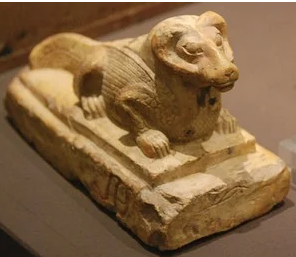
 Dua Sobek