Sobek’s solar associations illuminate his role as a force of life, creation and renewal. In the Pyramid Texts of the Old Kingdom, he already appeared with solar imagery, but it was from the Middle Kingdom onward that he was increasingly intertwined with the sun and merged with other solar gods (mainly Ra and Horus). Sobek Ra may be his most powerful and well-known syncretization, the composite blending the waters of the Nile with the Sun’s royal creative divinity.
The sun held profound centrality in Ancient Egyptian religion, the absolute heartbeat of creation, being the manifestation of life, creation, ma’at, renewal, and the eternal cycle of existence. It was a divine force that sustained the world and shaped cosmology. Ra, who was the sun, formed the core of Egyptian religious thought as he sailed across the sky each other, bringing light and order to the world. During the 12 hours of night, he journeyed through realms of the dead, merged with Osiris, and was reborn at dawn. Thus, we have eternal renewal and resurrection, and the daily victor of order over chaos.
The sun was sustainer, provider, protector, and promise of eternal life.
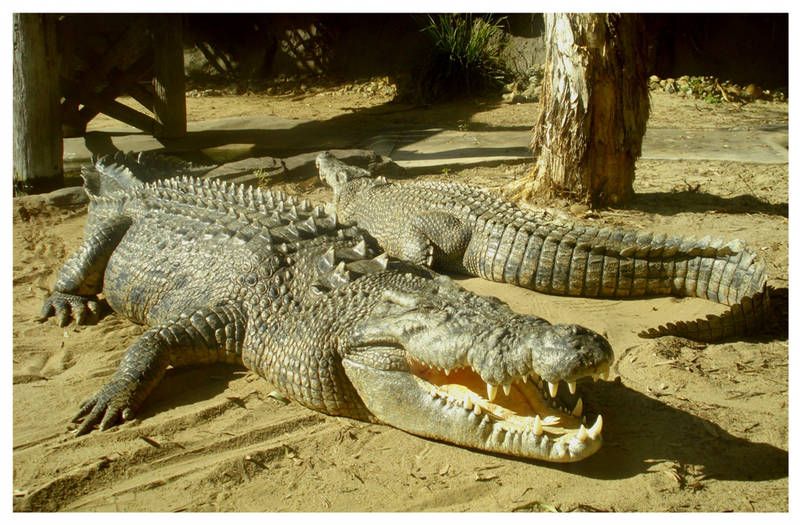
It is theorized that the crocodile’s association with the sun may have begun with their morning habit of emerging from the waters and basking, and return to the water (the Underworld) as the sun set. By the time of the Middle Kingdom, we see a hymn from the Papyrus Ramesseum VI invoke him as “who arises from the Nun, the great light maker, who comes forth from the flood water”, his emergence from the water mirroring the sun’s daily rising. The crocodile rose from the waters as did the sun at dawn, embodying solar principles through Sobek – emergence from chaos (waters), basking in the divine light, and daily, cosmic renewal.
Sobek Ra ascended to power and became prominent during the New Kingdom, “Sobek Ra, living sun, crocodile of the lake, shine upon us with your rays” (prayer from Tebtunis), and he is the sun incarnate. In Kom Ombo, he is crowned with the sun’s emblem in reliefs, and in a painting from the Fayum he is depicted with an oval solar disk with an uraeus on his head, surrounded by a pale pink nimbus with six rays. By the Ptolemaic period, his status as a sun god was deeply embedded, he “rises in the East and sets in the West”. His attributes regularly include a solar disk on his crown. His title “Lord of Bakhu” links him to the horizon, Bakhu is a mythical mountain sitting in the East where the sun rises.
It is in the Book of the Fayum, a mythological text composed in the Ptolemaic period in the Fayum Oasis, that Sobek is the sovereign power of the region. “The Fayum is in the power of Sobek” – the entire oasis is his temple, in which the Great Crocodile resides. In the book, Sobek is both the primeval flood made manifest, and fully syncretized with Sobek Ra as a solar deity – here, Sobek is Ra, he is the Sun, and at night the sun “sinks into the lake”, transforming into his crocodilian form to swim eastward through the lake, which is also the underworld. He battles the forces of chaos, mystically merges with Osiris, and rejuvenates to rise again as the glorious sun.
In the book it is written that “The mystery of Sobek is the mystery of Sobek Ra, steadfastly forever”. Sobek Ra is the unifying force of the inflowing flood and the wetlands, the central lake, rising from it in solar transformation, descending into the waters of the underworld at night as a crocodile.
Here, Sobek’s solar role reaches its most elaborate expression as Sobek Ra, the traditional Egyptian solar cycle becoming a Fayum-specific mystery.
Sobek’s solar association was customarily celebrated in cult practices, emphasizing renewal and light. Sobek as a sun god is one of celestial, kingly power and cyclical regeneration.
 Dua Sobek