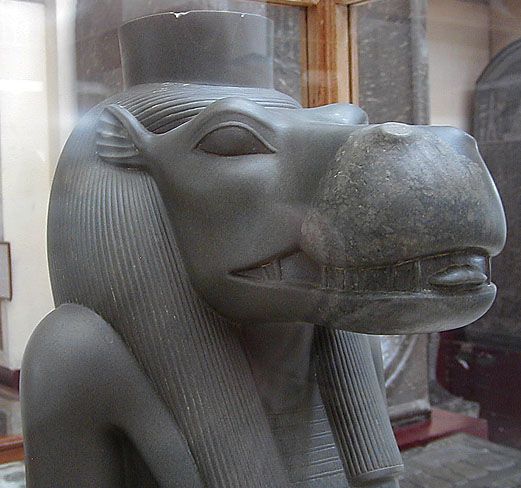
Taweret is known primarily as a goddess of childbirth and fertility, but her role extended beyond the birthing chamber to include household safety and the afterlife.
She is depicted as a bipedal female hippopotamus with a round belly, often with pendulous breasts, her composite form also having leonine paws and a crocodile tail or back. The hippo, the lion, and the crocodile were all very frightening animals, and their amalgamation in the goddess Taweret depicted a fiercely protective deity. She usually also holds the sa (protection) symbol, or holding a knife, and her headgear is a solar disk with horns or plumes.
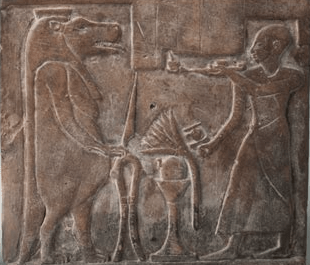
In at least two sources, Taweret was listed as Sobek’s mother. In the village of Kerkeosiris, near Tebtynis in the Fayum, was a small shrine of Petesuchos and Theories (Taweret), who was worshiped there as his mother (1), a nurturing maternal force to his crocodilian might. Her protective, life-giving essence and fierce maternal apotropaic qualities complements Sobek’s fierce protectiveness that he is so often prayed to for. The shrine at Kerkeosiris indicates a shared cultic space.
In the Book of the Fayum, Taweret is one of the divine protectors of Sobek Ra. She is called Taweret, the Great One and is positioned as his guardian during his nocturnal journey through the underworld waters of Lake Moeris. “Taweret stands at the prow, protecting the son of the lake”, linking her to Sobek Ra’s solar rebirth. Neith is said to take the form of Taweret, thus making Taweret Sobek’s mother here as well. On the Medinet Madi stone relief, which is from a temple dedicated to Sobek, a procession of deities circling Lake Moeris shows Taweret alongside Sobek and Neith.
Taweret was a goddess Sobek brought into my life, and had her idol placed alongside him on his altar. Considering their similarities, their relationship should come as no surprise. Both deities are potent powers that share a watery domain in the marshes and the Nile, violent protective natures, strong apotropaic qualities, and are both very fertile! Rooted in the Nile’s life-giving yet perilous waters, both embody the duality of life and death, nurturing and destruction.
Both deities wield animalistic ferocity to protect their devotees, Taweret especially invoked during childbirth, a very perilous time, her presence on birthing beds a shield and weapon. Sobek inherently brings the seed and male principle that fertilizes the land, Taweret is extraordinarily maternal and fecund. In a limestone stela from Abydos, Sobek and Taweret are depicted together, Sobek invoked as Lord of the Fayum and Taweret as Mistress of the House, and both are asked for strength and protection. They are again invoked together for protection on a relief in the Temple of Kom Ombo, as “Sobek, Lord of the Waters” and “Taweret, protector of the vulnerable”.
I feel I would be remiss without discussing how the Ancient Egyptians viewed hippos, in reference to Taweret. As cute as they are, hippos are kind of murder potatoes. They are very large and powerful, and bull hippos were viewed as being extremely dangerous and forces of chaos and destruction, linked to Sutekh. Female hippos, however, had more of a positive reputation, linked to fertility and noted for being extraordinarily fierce in the protection of their young. They become relentlessly aggressive against threats to their calves, which include male hippos, crocodiles, and lions. The female hippo’s round appearance, reminiscent of pregnant women, and their notable fury in guarding their young, was easily embodied in Taweret’s protection of mothers, infants, and the domestic sphere. Female hippos display a blend of nurturing care and lethal aggression and are intensely vigilant over their calves. They have been observed killing or driving off entire lion prides, and this fierce guardianship that blends physical power and maternal instinct is manifest in Taweret, who transformed the hippo’s formidable power into a symbol of safeguarding life.
Taweret aids divine births, guards Osiris’ rebirth, and is called on in birthing spells. She is often depicted with an open mouth with terrifying teeth, and I see this as reminiscent of a hippo’s roar and snarling visage as she wards off chaos and dangers to mothers and children.
In Ancient Egypt, Taweret’s cult was primarily domestic, lacking major temples, but there is plenty of evidence of personal devotions to her. Women wore amulets of her for protection during pregnancy, and tomb scenes show her on birthing beds, while household altars displayed her figurines. Offerings were made to her to ensure household safety, and one of her epithets is “Lady of the House”.
I have found Taweret to be an amazingly kind and deeply maternal goddess, who delights in prayers for protection, home blessings, and purifications and cleansings, and who strongly dotes on children. This is going very far into UPG territory, but I have established a monthly cleansing and protection ritual with Taweret during my period. I feel she is deeply vested in the health and welfare of women, and the ritual includes the cleansing and protection of my home as well as my person.
(1) Galuzina, M. The God Sobek In Ptolemaic and Roman Times: A Confrontation of the Cult of Sobek in Krokodilopolis and Kom Ombo (2016)
 Dua Sobek