Several scholars (Pinch, Wilkinson, Kees) have proposed that because of their complementary roles in fertility, creation, and the inundation of the Nile, Heqet and Sobek were paired as a divine couple in certain regional cults. The evidence for this is mostly pulled from temple reliefs, amulets, and votive offerings that juxtapose frog and crocodile imagery. However, technically, this is all inference and there is no hard evidence that documents Sobek and Heqet as consorts.
I do agree, though, that as a frog, marsh, and water goddess, she lives very closely to Sobek in the physical and mystical landscape. My UPG is that they are indeed closely linked, and Sobek had me place a Heqet idol on his altar. Heqet was, at the very least, venerated in the Fayyum, Sobek’s cult center, and it is written that she had a temple there.
While Heqet is primarily a goddess of fertility and midwifery – not only of birth, but death and rebirth as well – she can also be prayed to for protection, healing, and cleansing. In Heqet, there is life, abundance, and fecundity.
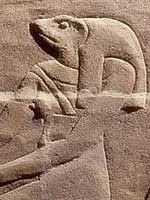
“The lotus flowers have arisen out of the flood and proclaim joy as the frog croaks, their faces bright, they begin rejoicing as the whole land becomes green.” ~ hymn translated from the Thesaurus Linguae Aegyptiae (1)
I put together a playlist to try and capture how she feels to me.
Epithets
- Mistress of All Water (mw nb)
- Mistress of Joy
- Lady of the Sky (mst ntrw)
- Lady of Life (nbt anx)
- Lady of the Embalming House (nbt pr nfr)
- The Primeval Mother (dfnt)
- She Who Gives Birth to the Gods (mst nTr)
- The Chief of the House of the Wet Nurse (xntyt Hwt xnmt)
- “She Who Hastens the Birth”
- “the frog is the Mistress of the knife”
- Mistress of the Two Banks (in reference to both banks of the Nile)
In Ancient Egypt, frogs were representative of creation, fertility, life, renewal, and rebirth. There were a lot of frogs along the banks of the Nile, and their watery fecundity came to be worshipped in the form of the goddess Heqet (also Heket, Hekat, Hqtyt), likely pronounced Haqatat. The hieroglyph hfn (tadpole) 𓆐 meant the number 100,000, or indicative of a very large amount. In a cute aside, ‘tadpole’ was also used as a personal name, hfnr.
Unsurprisingly, Heqet is heavily associated with water and watery locations. Where her temples are mentioned in the sources, they are always by bodies of water. In the biography of Petosiris (from his tomb at Tuna el-Gebel, late 4th century BC), we are told that during a procession in Heqet’s honor at Her-wer, Heqet asks for her temple, the House of Heqet, which had been destroyed by flooding to be restored. (1) Happily, Petosiris did rebuild the temple, and fortified it as well.
During the Middle and New Kingdom, Heqet was associated with three man-made lakes in the Saqqara-Abusir area, which were located near cemeteries and used in burial ceremonies. Funeral processions crossed the lakes on the way to the cemetery. Here, offerings were made to both Heqet and Khepri, and later Sokar, with the intent of regeneration and rebirth as one entered the underworld. Officials built their tombs on the ‘shores of Heket’, i.e. shores of the lake. (2)
In her protective capacity, Heqet carried knives, depicted with them on apotropaic wands, and was called the “Mistress of the Island of Flame”, and acted as an eye of Ra. Her name, along with the title “defender of the home”, has been found carved on clappers, a type of percussion instrument, to ward off evil from the noise they made. On the boundary stela of King Senwosret III, Heqet was called on for protection and defense. (1)
Heqet the Midwife – Life, Death, Rebirth
One of Heqet’s major roles was as a goddess of fertility. Women wore frog amulets in the hopes of becoming pregnant, to protect their unborn child, and called upon her during childbirth. She was depicted on “birthing bricks” (Ancient Egyptian women crouched on bricks to give birth – which is also not unlike the pose of a frog) as well as on the apotropaic birthing wands used in magic spells to protect mother and child. These wands were usually made of hippopotamus tusk, and were carved with protective gods and spirits for magical protection during childbirth.
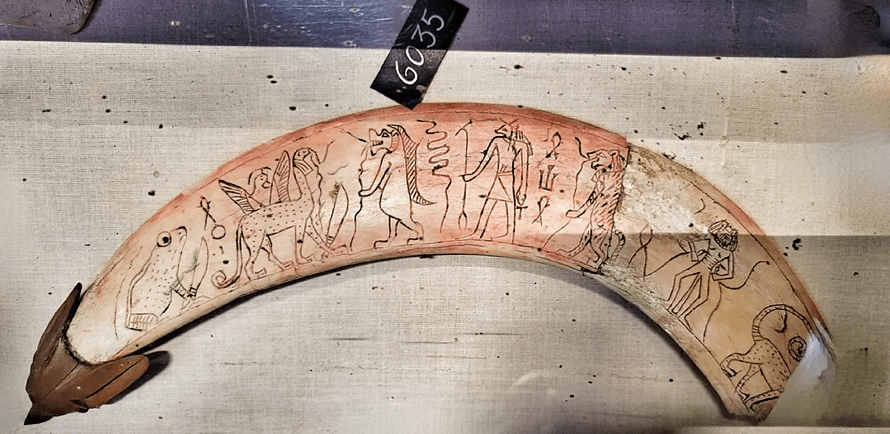
(Note the knifed-up froggie on the left.)
In the Westcar Papyrus, Heket, along with Isis, Nephthys, and Meshkenet (goddess of the birthing bricks), accompanied by Khnum, assist in “The Birth of the Three Kings”. Isis is in front of the mother, Nephthys behind her, while Heqet hastens the childbirth.
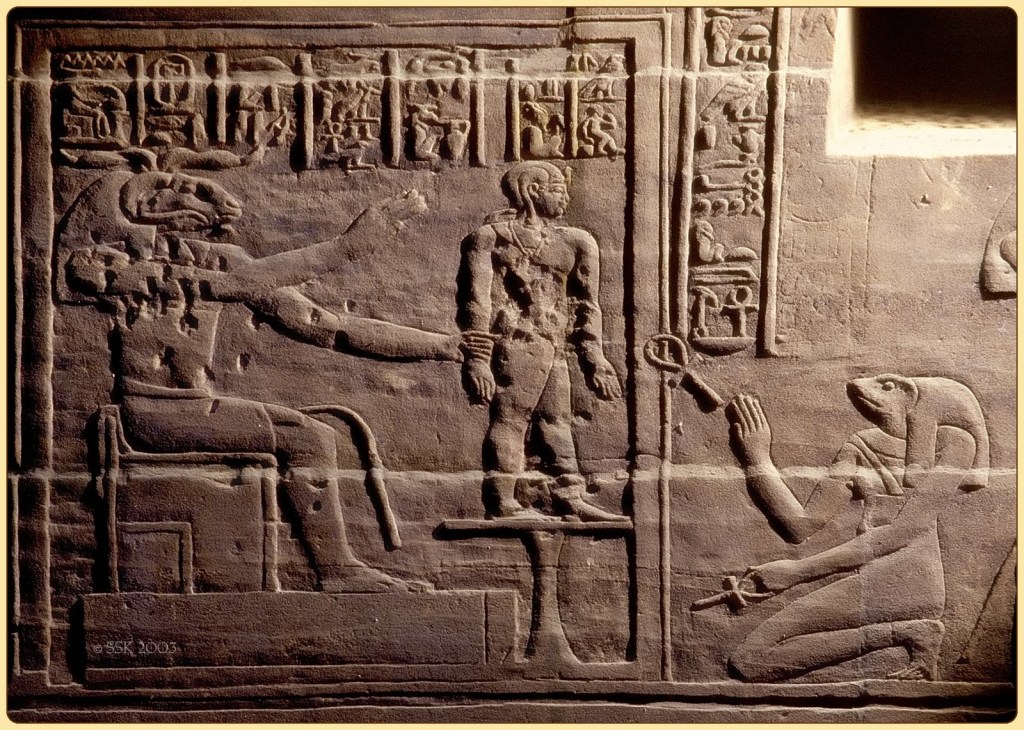
As the wife of Khnum, the ram-headed god who was pictured creating new humans on a potter’s wheel, Heqet gifted them life force.
Death, Burial, and Osiris
As Heqet ushered in life, so she ushered it out. She appears to have not only been the midwife of welcoming babies into the world, but also the midwife of death and rebirth into the underworld. During the Middle Kingdom in Abydos, along with Khnum, she had a prominent role in burial and resurrection rites. She guided the dead to the starry skies. In Spell 258 of the Pyramid Texts, titled “Not Perishing Forever”, Heqet ensures the deceased’s vitality and carries the ka of the dead to the Eastern horizon. (1)
As the cult of Osiris flourished, Heqet held an important role in his resurrection. She breathed new life into his dismembered body parts and was the midwife at his rebirth, bringing his soul back to his body as he rose from the dead. She appears on a relief from Denderah at the foot of the bier of Osiris as Isis and Nephthys weep for him. Osiris’ reconstitution also takes place in a marsh, quite appropriate for our frog goddess.
As Osiris’ body created life-sustaining grain, Heqet was also connected to grain germination, particularly during the flooding season, and immortality in the afterlife.
The life cycle of the frog – self-creating from the rich mud of the Nile, hatching from eggs into tadpoles, and morphing into a frog – were indicative of the stages of the soul as they moved from life to death to resurrection. Additionally, frogs shed their skins and appeared suddenly after rains, which are likely more reasons for Heqet’s association with rebirth.
Frog amulets, and more rarely, mummified frogs, were buried along with human mummies for both protection and to ensure resurrection. They were placed along the upper chest or throat during burial.
“I Am the Resurrection”
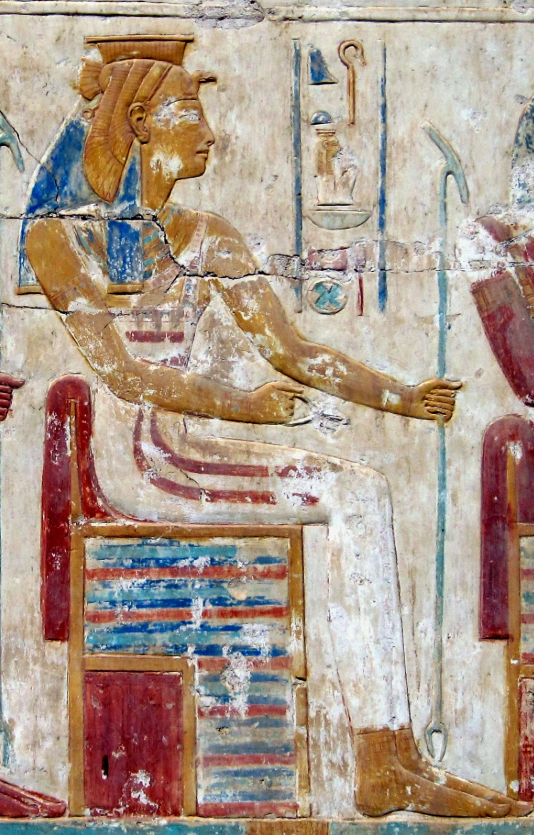
The hieroglyph for “frog” 𓆏 whm, translates as “repeating life”, or “to live again”, often written after the names of the deceased (3). This association of the frog with rebirth and resurrection carried over into Coptic Christianity, where ceramic oil lamps in the shape of a frog were marked with the phrase “I Am the Resurrection”.
My Experience with Heqet
I don’t use the word ‘vision’ lightly or often, but I believe the Divine and Holy Heqet blessed me with one.
In this vision, a white temple stood with an almost “chigi”-style roof, glowing softly in the middle of a dark marsh at night. It wasn’t very large, and was filled with water fountains, hanging plants – green and flowered – snakes, and frogs, who joined in the lulling songs of the night creatures.
Above was the starry night sky, and the feeling was ultimately indescribable, but I will try. It was the profound rapture of existence, a euphoria of beatitude, a sheer bliss between life and death and life again.
My hope is that you also are blessed and purified in the ethereal waters of Heqet the Starry Eyed.
And when you see a humble frog on a warm night, know perhaps that they are experiencing the ecstasy of creation as a natural state of being.
(1) Attia, Venice Ibrahim Shehatta. (2018). Heket the Frog Deity, the Khoaik Festival & Osiris Grain Mummies.
(2) Horvath, Zoltan. (2007) Remarks on the Temple of Heqet.
(3) Al-sayed Aman, Marzouk. (2015) The Frog In Ancient Egypt.
 Dua Sobek